| family | input | canonical |
|---|---|---|
| Length | 12 in | 0.3048 m |
| Length | 3.4 km | 3400 m |
| Mass | 2.5 lb | 1.13398 kg |
| Mass | 880 g | 0.88 kg |
| Temperature | 72 F | 295.37 K |
| Temperature | 24 C | 297.15 K |
Measurement Units Representation in Data Standards
Measurement fields should be explicit about value, unit symbol, and reference system. A stable representation avoids mixing inches with centimeters or Fahrenheit with Celsius in downstream analysis.
Unit standards and why they matter
Different standards solve different parts of the same interoperability problem:
- SI (BIPM) defines the canonical physical unit system (meter, kilogram, kelvin, second, etc.).
- UCUM defines machine-readable unit strings for data exchange (for example
mm,[lb_av],Cel,[degF]). - QUDT provides ontology-based identifiers and relationships for semantic data systems (for example linked-data style unit IRIs).
A practical pattern is:
- Accept source measurements in their original unit.
- Store a standard code/identifier (UCUM code or QUDT IRI).
- Normalize into SI canonical fields for analysis, joins, and model features.
This keeps your pipelines both human-readable and machine-safe across systems.
Recommended canonical pattern
Store original input and canonical SI values together:
{
  "schema": "measurement.v1",
  "length": {
    "value": 12,
    "unit": "in",
    "canonical_m": 0.3048
  },
  "mass": {
    "value": 2.5,
    "unit": "lb",
    "canonical_kg": 1.13398
  },
  "temperature": {
    "value": 72,
    "unit": "F",
    "canonical_k": 295.372
  }
}
Unit metadata checklist
- Include a machine-readable unit code (UCUM or agreed internal enum).
- Keep source value and source unit for traceability.
- Add canonical SI conversion fields for joins and aggregations.
- Validate ranges by unit family before persistence.
Data accuracy and lab recording
Unit discipline directly affects data accuracy and reproducibility:
- Prevents silent scale errors: e.g., treating
mgasgcauses \(10^3\) fold mistakes. - Preserves provenance: source value and source unit allow audit and reprocessing.
- Improves comparability: canonical SI fields make cross-instrument and cross-site analysis consistent.
- Supports lab workflows: records can keep both raw instrument output and normalized values used for statistics.
For laboratory recording, store at least:
- sample or specimen identifier
- measured value and source unit
- conversion method/version
- canonical value and canonical unit
- timestamp and instrument/context metadata
This structure helps ensure that downstream calculations (rates, concentrations, fold changes, thresholds) are traceable and repeatable.
Conversion examples
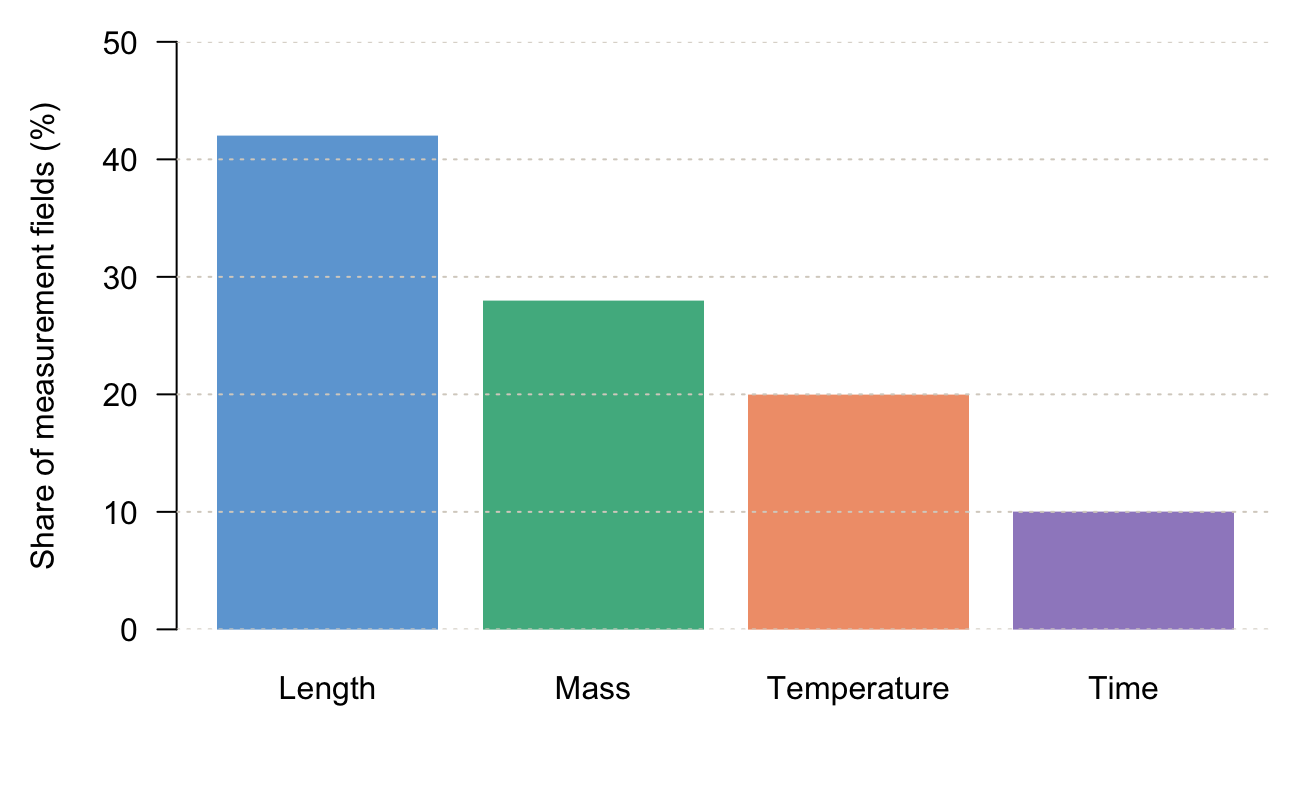
Distribution by unit family
Interactive companion
Use ED measurement units standards to input values, convert to SI canonical fields, and inspect a live distribution chart.